Fifty-Six Hours to Replace a Highway Crossing: How Accelerated Bridge Construction Rewrote the Schedule

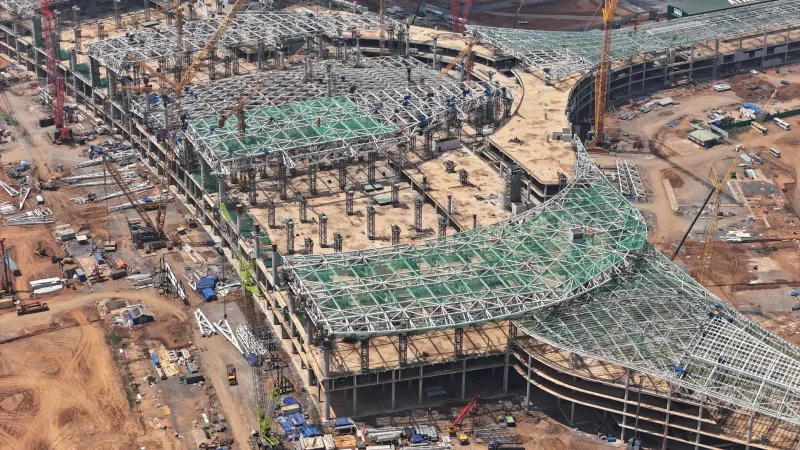
Photo: Joeyuna, CC BY-SA 4.0, via Wikimedia Commons
For most of the twentieth century, replacing a highway bridge followed a familiar script: close the crossing, detour the traffic, and settle in for eighteen months to three years of on-site construction. Motorists grumbled, local businesses absorbed the losses, and the schedule stretched as weather and conflicts intervened.
That script is being rewritten. Across state departments of transportation, accelerated bridge construction—ABC in industry shorthand—has moved from experimental demonstration to standard procurement practice, and its implications reach well beyond the bridge deck.
The Mechanics of the Weekend Swap
At its core, ABC relocates most construction activity off the critical path. Foundations, abutments, piers, and deck sections are fabricated in controlled off-site conditions, then assembled or installed during brief closure windows. Three techniques dominate the current toolkit:
- Self-propelled modular transporters (SPMTs): Multi-axle platform systems capable of carrying a completed, fully equipped bridge span—deck, rails, and utilities included—into position at highway speed. A structure weighing thousands of tons rolls in on remote-controlled wheel lines and is lowered onto prepared abutments.
- Precast substructure elements: Factory-produced footings, columns, and abutment units that eliminate weeks of on-site formwork and curing, often installed in overnight windows between peak traffic periods.
- Slide-in deck replacement: New superstructures built alongside the existing alignment, then slid laterally into place during a single weekend closure.
The signature projects are now part of American infrastructure lore. Utah DOT, an early and aggressive ABC adopter, has replaced dozens of structures using SPMTs, including the well-documented 2008 swap of the 4500 South bridge over I-215 in Salt Lake City, where the old span was demolished and its replacement installed over a single weekend. MassDOT's 91-day rapid replacement of Boston's Commonwealth Avenue bridge over the Mass Pike demonstrated the same philosophy in a dense urban core. State programs in New York, Oregon, and Virginia have since institutionalized the methods through standard details and prequalified contractor lists.
Why the Schedule Is the Product
The economics of ABC are frequently misunderstood. On a pure materials basis, precast and modular approaches can carry a premium of ten to twenty percent over conventional cast-in-place construction. What the premium purchases is time—and time, on a functioning highway corridor, is the most expensive commodity in the project.
A full closure of an interstate crossing imposes costs that never appear on a contractor's invoice: freight delays, detour fuel, lost retail revenue, emergency response detours, and the compounding disruption to adjacent construction. Federal highway economic models have long assigned substantial daily values to urban corridor closures. Measured against those figures, a weekend that would have been a season is not a premium; it is a discount.
For the agencies, ABC also compresses exposure to the classic risks of long-duration work—weather windows, traffic incidents in work zones, and workforce turnover—that historically turned eighteen-month estimates into thirty-month realities.
What It Means for Enterprise Bidders
For private developers and design-builders pursuing time-sensitive corridor work, the competitive calculus has shifted. ABC capability is increasingly a qualification gate rather than a differentiator. Agencies writing contracts with liquidated damages tied to closure windows effectively demand it.
Three capabilities separate serious ABC bidders from the rest:
- Fabrication relationships and logistics capacity. A weekend swap succeeds or fails on whether the superstructure arrives complete, on time, and within tolerance. Firms without locked-in precasting partnerships are bidding on hope.
- Heavy-moves engineering. SPMT operations demand transport analysis, route surveys, and temporary works design that many traditional bridge contractors have never performed. The learning curve is real and unforgiving in front of live traffic.
- Possession planning discipline. ABC converts a construction project into a logistics operation with a hard deadline measured in hours. The firms that excel treat the closure window with the rigor of a launch sequence—rehearsed, sequenced, and redundant where it matters.
The Direction of Travel
The trajectory is clear. As SPMT capacities grow and precast standardization deepens, the multi-year closure will become the exception reserved for the most complex urban reconstructions. The expectation, set by projects that returned a highway to service by Monday morning, is now permanent.
For developers, the message is straightforward: the industry stopped buying construction time and started buying open roads. The bidders who internalize that distinction will find the corridor work is going to someone else.