Seven Digits of Regret: Pre-Construction Failures That Were Visible on Day One
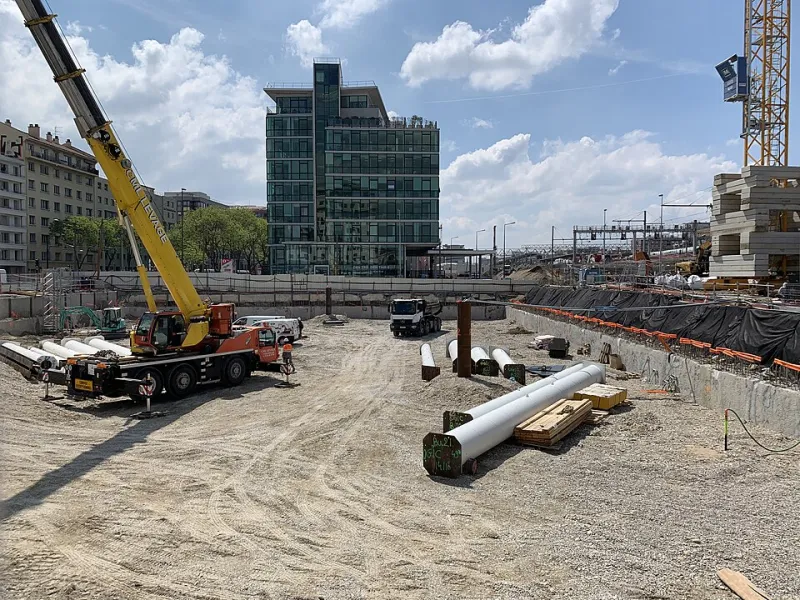
Photo: Benoît Prieur, CC0, via Wikimedia Commons
Post-mortems in construction tend to focus on what went wrong in the field. But a surprising share of the industry's most expensive failures were fully visible before anyone broke ground — documented in a report, flagged in a survey, or buried (literally) a few feet below grade. The problem was never a lack of information. It was a lack of someone assigned to act on it.
Here are five failure patterns that recur across American projects of every size, each paired with the checklist discipline that stops it.
1. The Utility Nobody Owned
The failure: A mid-size municipal project proceeds on records that show a clear alignment. Excavation uncovers an unmapped fiber trunk serving a regional hospital. Relocation, emergency redesign, and contractual delay claims stack into seven figures.
The fix: Never treat as-built drawings as ground truth. Mandate a subsurface utility investigation — vacuum-excavated test holes at conflict points, classified to ASCE 38 standards — and assign a named person to reconcile every utility pothole result against the design before 60% drawings.
2. The Geotechnical Assumption That Traveled
The failure: A foundation design borrows soil parameters from a report completed for an adjacent parcel years earlier. Borings on the actual site — never drilled — would have revealed fill of inconsistent depth. Change orders for over-excavation and revised foundations follow.
The fix: Require that every structural design reference borings taken within the project footprint, within a defined recency window. If the report predates the design by more than a season, re-verify. Soil does not respect property lines or old report dates.
3. The Permit Condition Read by No One
The failure: An environmental approval contains a seasonal restriction on in-water work. The condition is accurate; the schedule ignores it. By the time the crew mobilizes, the window has closed, and the project waits months — with equipment sitting idle on the clock.
The fix: Build a permit-condition register as a living project document. Every obligation gets an owner, a date, and a line in the master schedule. Review it in every pre-construction meeting, not just at kickoff.
4. The Stakeholder Discovered Too Late
The failure: Design proceeds for months before a railroad, a tribal authority, or a neighborhood association with real procedural leverage surfaces. Their review requirements restructure the sequence entirely.
The fix: Map every party with approval or objection power before schematic design, and interview them. A two-week early conversation is the cheapest schedule insurance available anywhere in this industry.
5. The Estimate That Assumed Perfect Access
The failure: Logistics planning assumes standard delivery routes and laydown space. In reality, a constrained urban site forces night deliveries, smaller loads, and double-handling — costs that surface as premium pricing during execution.
The fix: Treat site logistics as a designed system, not an assumption. Conduct a delivery-path study during estimating and price the worst credible scenario, not the average one.
The Common Thread
Every one of these failures shares a signature: the information existed, but no single role was accountable for converting it into action. Forensic discipline in pre-construction isn't about more reports. It's about fewer orphaned facts — and a checklist culture where every critical assumption has a name attached to it before the shovel moves.