The Intelligent Jobsite: How AI Is Rewriting the Rules of Infrastructure Development
Photo: Martinimarcello00, CC BY 4.0, via Wikimedia Commons
There is a version of the AI conversation that infrastructure professionals have grown weary of—the breathless prediction that machine learning will replace engineers, that autonomous systems will render human judgment obsolete, that the entire discipline is on the verge of wholesale transformation. That version of the conversation is not particularly useful.
The more useful version acknowledges something quieter and more significant: AI is already changing how infrastructure gets designed, inspected, and maintained, and the firms that have integrated these tools thoughtfully are outperforming those that haven't in ways that are measurable, documented, and growing. The question for enterprise clients and their development partners is no longer whether to engage with AI—it is how to do so with enough rigor to realize genuine value rather than merely checking a technology adoption box.
Design Intelligence: From Iteration to Optimization
Generative design—the use of AI algorithms to produce and evaluate thousands of design configurations against defined engineering and cost constraints—is perhaps the most mature application of machine learning in infrastructure development today. What previously required weeks of iterative drafting and manual analysis can now be compressed into hours, with the system surfacing configurations that human designers might never have considered.
In practice, the value is not that AI replaces the structural engineer or the civil designer. It is that it dramatically expands the solution space that those professionals can explore within a given timeframe. A bridge deck design that must balance material cost, load distribution, constructability, and environmental footprint involves trade-offs that are difficult to optimize manually at scale. Generative design tools can evaluate tens of thousands of permutations and present ranked options with supporting analysis, allowing the engineering team to apply their judgment to a better-informed shortlist.
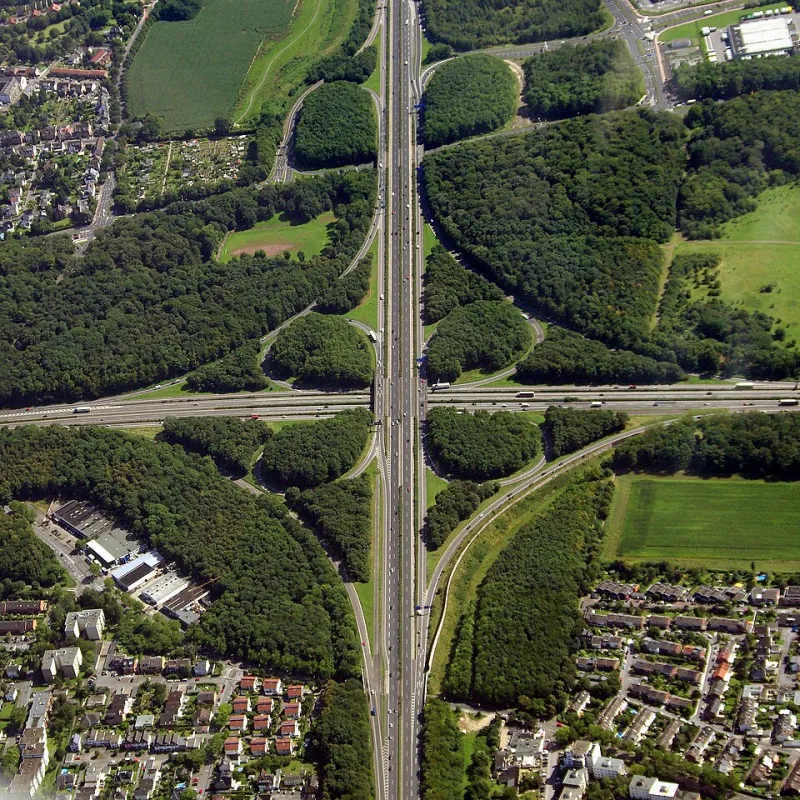
Firms working on transportation infrastructure—highway interchanges, rail corridors, port facilities—have reported measurable reductions in material costs and construction complexity when generative design is introduced early in the project lifecycle. The gains are most significant when the AI is given real project constraints rather than generic parameters, which means the quality of the input data remains a critical variable.
Inspection at Scale: What Drones and Computer Vision Are Actually Delivering
The combination of drone-mounted sensors and AI-powered image analysis has fundamentally altered the inspection economics for large infrastructure assets. A visual inspection of a major bridge that once required lane closures, specialized access equipment, and several days of field time can now be completed in a fraction of that time using unmanned aerial systems equipped with high-resolution cameras and LiDAR.
But the hardware is only part of the story. The more significant development is the maturation of computer vision models trained to identify structural anomalies—cracking patterns, section loss, joint displacement, surface delamination—with a consistency and speed that manual inspection cannot match at scale. The Federal Highway Administration has been engaged in ongoing research into AI-assisted bridge inspection, and several state DOTs have begun integrating these tools into their asset management programs.
For private infrastructure developers and their enterprise clients, the implications extend beyond maintenance. AI-powered inspection data, when collected longitudinally, generates the kind of asset condition record that enables predictive maintenance modeling. Rather than scheduling inspections and interventions on fixed calendars, operators can shift toward condition-based maintenance regimes that deploy resources where and when degradation is actually occurring—reducing both cost and the risk of unplanned failure.
The practical barrier here is data standardization. Inspection data collected by different systems, at different resolutions, using different classification schemas, does not aggregate cleanly. Organizations that are serious about building predictive maintenance capability need to establish data governance frameworks before the sensors go up, not after.
Risk Management in Real Time
Perhaps the most consequential application of AI in critical infrastructure is real-time structural monitoring combined with machine learning-based risk assessment. Sensor networks embedded in bridges, dams, tunnels, and utility infrastructure can now transmit continuous performance data—strain, vibration, deflection, thermal expansion—to analytical platforms that compare observed behavior against modeled baselines and flag deviations that warrant investigation.
The 2007 collapse of the I-35W bridge in Minneapolis remains a reference point in American infrastructure safety discourse. Post-event analysis revealed that warning signs existed in the structural data but were not identified in time to trigger intervention. The sensor and analytics technology that exists today could not have prevented every failure of that kind—but it would have materially changed the information available to the engineers responsible for that asset.
Several large-scale infrastructure projects currently under development in the United States are incorporating structural health monitoring as a designed system element rather than a retrofit consideration. This represents a meaningful shift in how developers and asset owners are thinking about the long-term value proposition of monitoring investment.
The honest caveat is that AI risk models are only as reliable as the failure data they were trained on—and for many infrastructure asset types, that failure data is limited. The industry does not have thousands of documented bridge collapses from which to build robust predictive models. This means current systems are better at identifying anomalies than at predicting specific failure modes, and human expert review remains essential in the analytical loop.
The Adoption Gap and Why It Persists
If the tools are this capable, why isn't every infrastructure developer deploying them? The barriers are real, and they deserve honest acknowledgment.
First, the talent gap is significant. Implementing AI-driven design and inspection tools requires personnel who understand both the engineering domain and the technology well enough to configure, validate, and interpret the systems. That combination of competencies is genuinely scarce, and the competition for people who possess it extends well beyond the infrastructure sector.
Second, the procurement and liability frameworks that govern much of public infrastructure work in the United States were not written with AI-assisted workflows in mind. Questions about who bears responsibility when an AI-generated design element fails, or when a computer vision system misclassifies a defect, remain unresolved in many jurisdictions. Until those frameworks are clarified, some developers will rationally limit their exposure.
Third, there is institutional inertia. Infrastructure development is a discipline with deep professional traditions, and the firms that have built successful practices over decades have legitimate reasons to be cautious about tools that have not yet accumulated the track record of the methods they are being asked to replace.
None of these barriers are permanent. The talent pipeline is developing, the regulatory frameworks are evolving, and the track record is being built with each successful deployment. But they are real constraints that enterprise clients and their development partners should factor into adoption timelines.
A Considered Path Forward
The infrastructure firms that will be best positioned five years from now are not necessarily those that moved fastest to adopt every available AI tool. They are the ones that identified the highest-value applications within their specific project types, built the data infrastructure to support those applications properly, and developed the internal expertise to use the tools with appropriate rigor.
At Slinfra Developers, our engagement with AI-driven design and inspection technology is grounded in that philosophy. We are not adopting these tools because they are current; we are deploying them where they demonstrably improve outcomes for our clients and the infrastructure assets we are collectively responsible for building. The intelligent jobsite is not a destination—it is a direction, and the journey requires the same disciplined engineering judgment that has always defined this industry at its best.