After Dark, Before Deadline: The Quiet Rise of America's Overnight Construction Economy
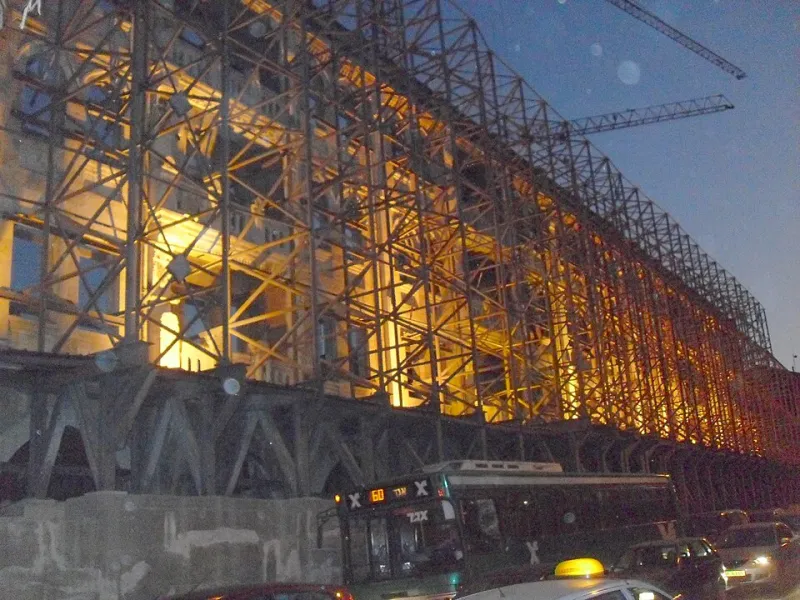
Photo: Utilisateur:Djampa - User:Djampa, CC BY-SA 4.0, via Wikimedia Commons
Walk down any major American downtown corridor at 2 a.m. and you may notice something new: floodlights, excavators, and crews pouring concrete while the city sleeps. What looks like an anomaly is fast becoming a strategy. Across dense metros from Chicago to Seattle, infrastructure developers are discovering that the most valuable real estate on a project schedule isn't a location — it's a time slot.
The Daylight Tax Nobody Budgets For
Traditional daytime construction in an urban core carries costs that rarely appear on a bid sheet. A lane closure on a downtown arterial can add minutes to tens of thousands of vehicle trips daily. Retailers along a blocked sidewalk report revenue drops that ripple into lease negotiations. Emergency vehicle response times lengthen. Individually, these are inconveniences; collectively, they represent a genuine economic drag that cities increasingly expect contractors to account for.
Some jurisdictions have begun quantifying it. Road user costs — the formal metric agencies use to price traveler delay — can run into six figures per day on high-volume corridors. When a project's daytime footprint spans months, the delay bill can rival the cost of the infrastructure itself.
Engineering the Night
Moving work to off-hours sounds simple. Executing it well is not. Overnight construction introduces its own discipline, and the firms doing it successfully tend to share three practices.
Acoustic containment as a design requirement. Modern jobsite sound blankets, perimeter noise barriers, and equipment retrofits — hushed backup alarms, electric gensets in place of diesel — allow crews to meet even strict municipal ordinances. In cities like Boston and Washington, D.C., where residential density abuts nearly every work zone, acoustic planning is now a pre-bid deliverable, not an afterthought.
Phased logistics that respect the morning. The defining constraint of night work is the hard deadline: everything must vanish before rush hour. That demands a choreography of staged materials, pre-assembled components, and rapid-demobilization plans. Modular and prefabricated elements, fabricated offsite during the day and installed overnight, have become the linchpin of this model — compressing what was once a week of lane closures into a single 56-hour weekend or a series of quiet weeknights.
Community compensation and good-faith agreements. The most forward-thinking developers no longer treat neighborhood friction as a public-relations problem. They negotiate it. Hotel districts receive soundproofing contributions. Restaurant corridors get phased access guarantees and, in some programs, direct mitigation payments. These agreements cost a fraction of litigation or council-imposed work stoppages — and they buy something harder to price: permission to operate.
Where the Savings Show Up
For enterprise clients — municipalities, transit authorities, universities, hospital systems — the overnight model delivers value in three currencies. First, schedule compression: shorter calendar durations mean earlier asset availability and reduced escalation exposure. Second, avoided externality costs: fewer business disruption claims, lower road user costs, reduced traffic-control expenditures. Third, risk reduction: night crews on closed roadways face far less interaction with live traffic than their daytime counterparts.
The model isn't universal. Utility work requiring inspections, projects in noise-sensitive zones without mitigation budgets, and scopes dependent on daylight visibility all resist the night shift. And labor considerations — differential pay, fatigue management, supervision coverage — must be engineered into the estimate honestly, not papered over.
The Question to Ask at Procurement
The practical takeaway for anyone buying infrastructure services is straightforward: make scheduling strategy an explicit evaluation criterion. Ask bidders to model the cost of daytime disruption alongside the cost of nighttime execution. Require a noise and logistics plan as a submittable. Where the math favors the night — and in dense American cores, it increasingly does — the winning bid may be the one written for the hours nobody else wants.
The cities that build fastest in the coming decade may not be the ones with the biggest budgets. They may be the ones willing to build while everyone else is asleep.