Pricing the Sky: The Quiet Renegotiation of Climate Risk in American Construction Contracts
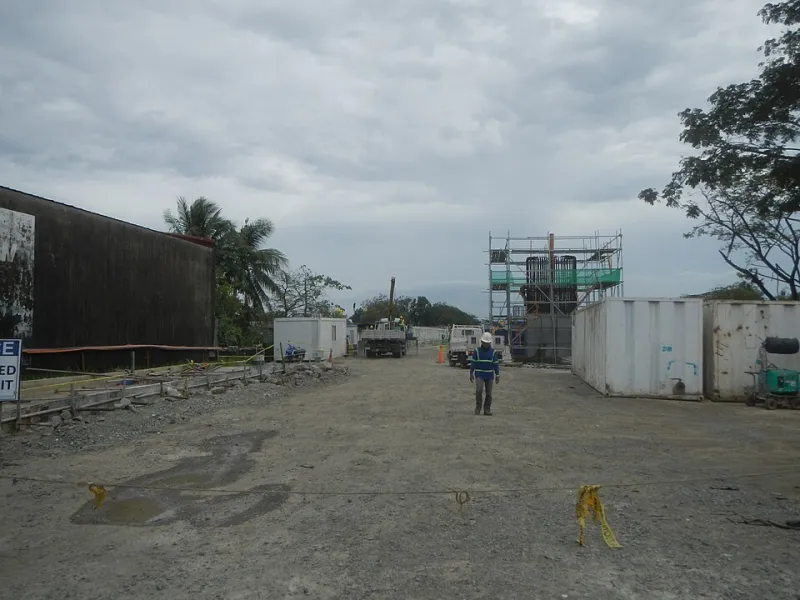
Photo: Judgefloro, CC0, via Wikimedia Commons
For most of the twentieth century, the weather clause in a construction contract was boilerplate. A few lines about acts of God, a reference to force majeure, and a shared assumption that extreme events were rare enough to be treated as statistical outliers. That assumption no longer holds. Across the United States, general contractors, developers, and enterprise clients are discovering that the allocation of climate risk — once an afterthought buried in Exhibit D — now sits at the center of pre-construction negotiations.
The numbers explain why. NOAA's National Centers for Environmental Information has recorded a sustained rise in billion-dollar weather disasters, and construction sites sit squarely in the path of that trend. A hurricane-delayed port expansion in the Gulf, a heat wave that halts asphalt work across the Southwest for two weeks, a flash flood that scours out a temporary crossing on a highway project in the Missouri River basin — these are no longer tail risks. They are line items.
The End of the Symmetrical Clause
Traditional force majeure language was built on symmetry: neither party anticipated the event, so neither party bears disproportionate blame. But climate volatility has broken that symmetry in practice. An owner who selected a coastal site knew, or should have known, about accelerating flood exposure. A contractor who bid a twelve-month schedule in a region with lengthening fire seasons cannot credibly claim that wildfire smoke days were unforeseeable.
The result is a quiet but decisive shift toward what contract attorneys describe as "knowability" language. Newer agreements increasingly distinguish between weather events that are foreseeable at the time of bidding — and therefore priced into the schedule and budget — and genuinely anomalous events that trigger relief. The distinction matters enormously. Under many emerging contract structures, a contractor absorbs the cost of the hundredth-year storm that arrives as the tenth-year storm it has become, while relief provisions are reserved for the truly unprecedented.
Who Eats the Cost When the Sky Doesn't Cooperate
Three models are competing for dominance in US markets, and the differences between them are reshaping how enterprise clients evaluate bidders.
The first model concentrates weather risk with the contractor. Owner-controlled insurance programs and fixed-price contracts increasingly push delay exposure downstream, on the theory that contractors price risk more efficiently than owners. Contractors, in turn, are responding with weather-indexed bid pricing — building historical NOAA precipitation and temperature data for the specific project window directly into their schedules rather than applying generic seasonal allowances.
The second model distributes risk through parametric instruments. Rather than litigating whether a storm was severe enough to justify a time extension, some programs now tie parametric insurance triggers to objective thresholds: wind speed at a named monitoring station, rainfall totals at the nearest airport gauge. Payouts arrive in days, not years, and the contractual fight largely disappears. For large public-private partnerships, this approach is gaining traction precisely because it converts an adversarial claims process into an actuarial calculation.
The third model — and the one raising the sharpest questions — places shared weather risk in a true-up mechanism. Under these arrangements, both parties agree on a baseline of expected weather days, and deviations beyond that baseline are shared according to a negotiated formula. It resembles the escalation clauses long used for steel and fuel, applied to the atmosphere itself.
The Language Innovations Worth Watching
Several contract drafting innovations are moving from novel to standard across US markets. Weather day definitions are being tightened to specify not just precipitation thresholds but working-condition criteria — the point at which heat index, air quality, or wind speed renders a specific activity infeasible. Schedule float ownership is being clarified so that weather delays do not silently consume float that either party believed was theirs. And notice provisions are shortening dramatically, with some owners requiring weather-related claims documentation within seventy-two hours, effectively demanding that field teams maintain near-real-time site condition records.
Sophisticated enterprise clients are also asking a question that would have sounded strange a decade ago: what climate data did the bidder actually use? A schedule built on thirty-year historical averages for a region where the last decade has materially diverged from that baseline is not a neutral document. It is a pricing position, and owners are learning to interrogate it.
The New Due Diligence
For organizations commissioning large infrastructure, the practical implications are straightforward. Climate risk allocation should be evaluated during procurement, not discovered during claims. Bidders should be asked to disclose the weather assumptions underlying their schedules. Insurance structures should be aligned with contract language, so that a parametric trigger and a force majeure definition do not describe the same event differently.
The weather clause was always a bet about the future. The difference now is that everyone at the table knows it — and the parties who price that bet honestly are the ones whose projects survive contact with an increasingly volatile sky.